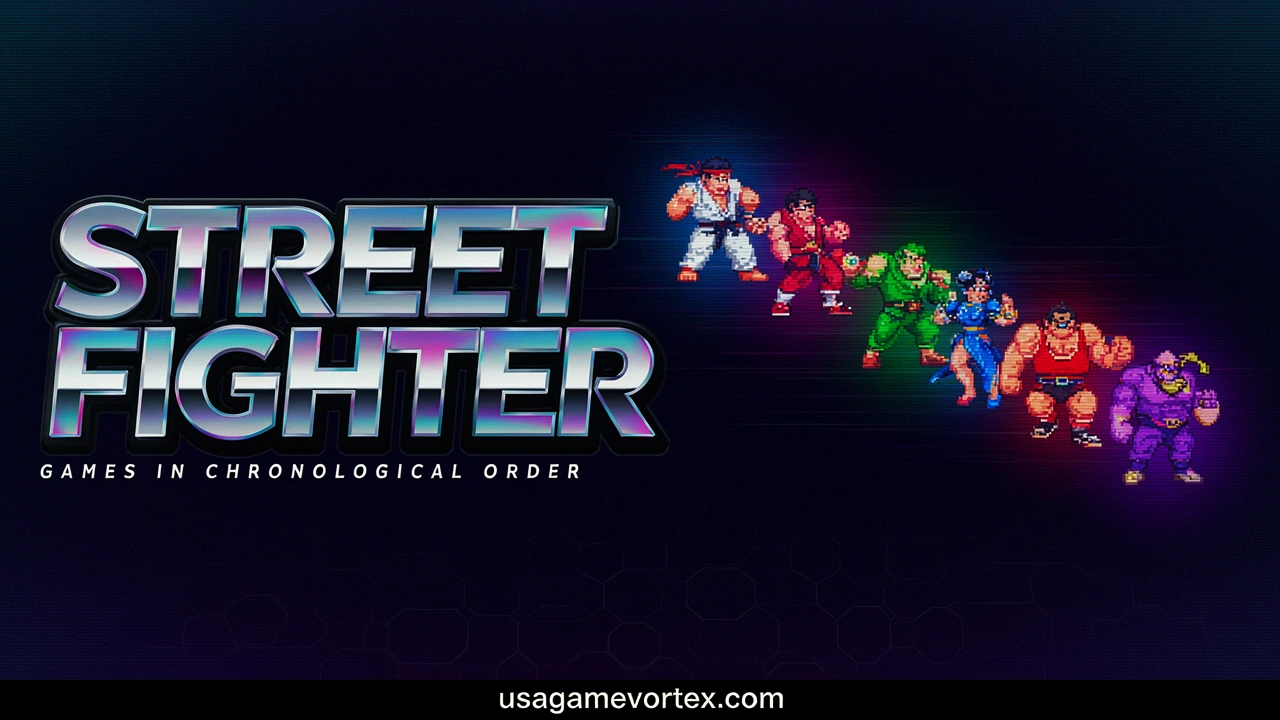
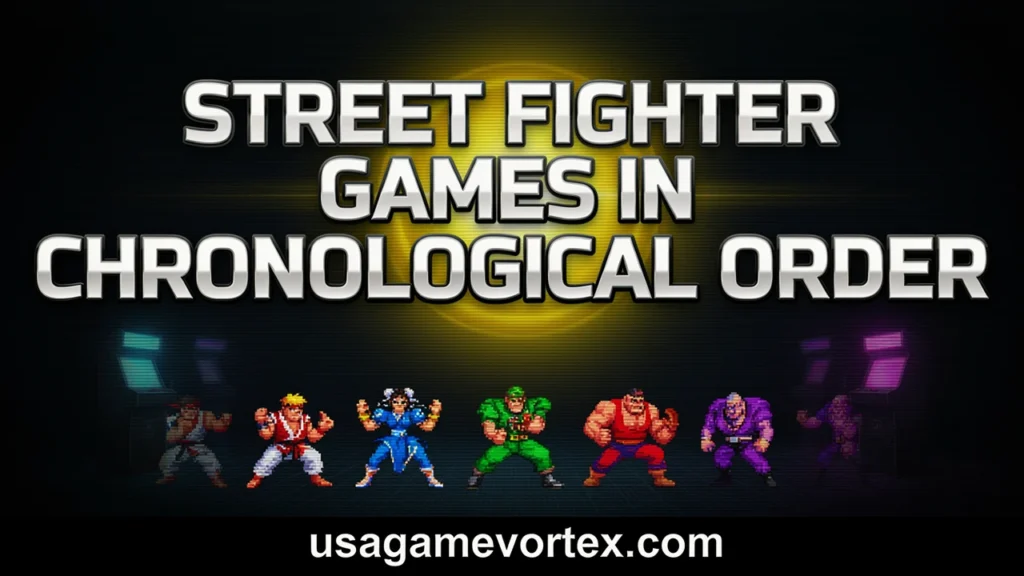
Street Fighter Games in Chronological Order
Street Fighter’s numbering is confusing. Street Fighter II arrived before the Alpha games, Alpha is a prequel to II, and Street Fighter V is set before Street Fighter III. Add the EX games, the crossovers and years of re-releases, and it is hard to tell what came when.
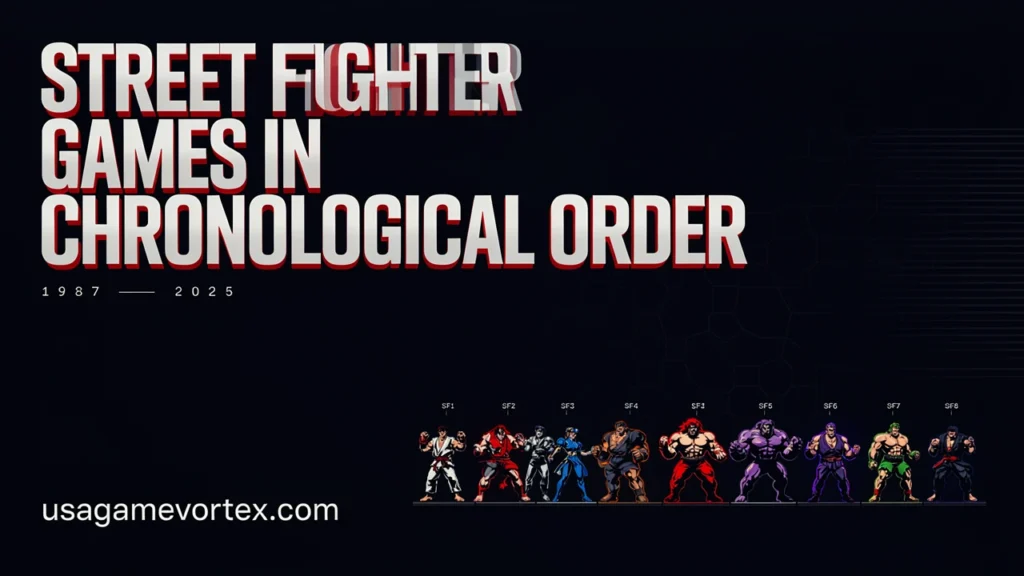
Here is the clean version. By release date, the main Street Fighter series runs like this: Street Fighter (1987), Street Fighter II (1991), Alpha (1995–1998), III (1997–1999), IV (2008–2009), V (2016) and Street Fighter 6 (2023). The rest of this guide fills in the spin-offs, the story order and where you should start.
How Many Street Fighter Games Are There?
There are seven numbered main entries, but dozens of releases once you count updates, spin-offs and collections.
The numbered line is Street Fighter, II, III, IV, V and 6. The Alpha sub-series is the seventh branch, because Capcom never gave it a number. The count balloons because Capcom kept re-releasing its fighting games with new characters and balance changes. Street Fighter II alone was reissued five times in the arcade between 1991 and 1994. Street Fighter IV and V each got two major upgrades.
Which Street Fighter Should You Play First?
Start with Street Fighter 6 if you want to play now, or Street Fighter II if you want the history.
Street Fighter 6 is the current mainline game. It is the most active, has the largest online population, and is the easiest to learn thanks to its Modern Controls. Capcom reports it has sold over 7 million copies. If you prefer to work through the series from the beginning, the Street Fighter 30th Anniversary Collection (2018) is the most practical route. It bundles 12 classic arcade games, from the original Street Fighter through III: Third Strike.
Street Fighter Games in Order of Release
Here is the main timeline at a glance:
| Year | Game | Why it matters |
|---|---|---|
| 1987 | Street Fighter | Introduced Ryu, Ken and the six-button layout |
| 1991 | Street Fighter II: The World Warrior | Started the competitive fighting game boom |
| 1992–1994 | Champion Edition, Hyper Fighting, Super, Super Turbo | Refined II with playable bosses and new moves |
| 1995 | Street Fighter Alpha: Warrior’s Dreams | Anime-style redesign and a prequel story |
| 1996–1998 | Alpha 2, Alpha 3 | Added Custom Combos, Super Combos and a huge roster |
| 1997–1999 | III: New Generation, 2nd Impact, 3rd Strike | Almost entirely new cast and the parry system |
| 2008–2014 | IV, Super IV, Arcade Edition, Ultra IV | Revived the series with a 3D look on a 2D plane |
| 2016–2020 | V, Arcade Edition, Champion Edition | Longest post-launch support cycle so far |
| 2023–present | Street Fighter 6 | World Tour mode, Modern Controls, ongoing seasons |
Street Fighter (1987)
The original arcade game introduced Ryu and Ken, but it is a rough experience today. It featured a tournament-style structure, a two-button-size pressure pad on some cabinets and a hard-to-execute special move system. Special moves like the Hadoken were hidden, and many players never discovered them. Sagat served as the final boss. It is worth playing as a historical curiosity, not as a starting point.
Street Fighter II: The World Warrior (1991)
This is the game that made the series famous. Eight selectable World Warriors, a six-button layout and combo-friendly timing turned the arcade into a competitive scene. Ryu, Ken, Chun-Li, Guile, Blanka, Zangief, Dhalsim and E. Honda were playable, with Balrog, Vega, Sagat and M. Bison as the final four opponents. Capcom then released the upgrades: Champion Edition, Hyper Fighting, Super Street Fighter II and Super Street Fighter II Turbo. Each one added features such as playable bosses, extra speed or new characters like Cammy and Fei Long. SOURCE: Den of Geek
Street Fighter Alpha Series (1995–1998)
Alpha is where Street Fighter got its anime-influenced look. Street Fighter Alpha: Warrior’s Dreams (1995) brought back fighters from the original game and introduced Sakura and Charlie. Alpha 2 (1996) refined the system, and Alpha 3 (1998) is widely remembered for its huge roster and three fighting styles, called isms. The series adds Alpha Counters and Super Combos, which give it a distinct feel from II.
Street Fighter III (1997–1999)
Street Fighter III replaced most of the cast with new faces and changed how defense works. New Generation (1997) introduced Alex, Ibuki, Yun, Yang, Dudley, Elena, Oro and Sean, with Gill as the final boss. 2nd Impact added Akuma and Urien. Third Strike (1999) is the one competitive players still talk about, largely because of the parry: a well-timed tap toward an incoming attack negates it. Third Strike is also famous for Evo Moment 37, the 2004 Daigo Umehara comeback against Justin Wong.
Street Fighter EX and the Non-Mainline Games
Not every Street Fighter game follows the main path. Here are the notable ones:
- Street Fighter EX series (1996–2000): A polygon-based side series developed by Arika, with fighters such as Skullomania and Blair Dame.
- Street Fighter: The Movie (1995): An arcade game built with digitized actors from the Jean-Claude Van Damme film.
- Super Puzzle Fighter II Turbo (1996): A puzzle game with chibi versions of the cast.
- Super Gem Fighter Mini Mix (1997): Also known as Pocket Fighter, a comedic fighter with costume changes.
- Street Fighter X Tekken (2012): A tag-team crossover with Bandai Namco’s series.
- Street Fighter X Mega Man (2012): A free fan-tribute platformer released to celebrate both franchises.
- Street Fighter: Duel: A mobile RPG that pulls characters from across the series.
Street Fighter IV (2008)
Street Fighter IV brought the series back after a decade of relative quiet. Arcades got it in 2008 and consoles followed in early 2009. It kept the classic 2D gameplay but wrapped it in 3D visuals, and added Focus Attacks and Ultra Combos. Later versions, Super Street Fighter IV (2010), the Arcade Edition (2011) and Ultra Street Fighter IV (2014), grew the roster and adjusted balance. It also introduced Seth, Abel, Crimson Viper and Rufus, among others.
Street Fighter V (2016)
Street Fighter V launched in February 2016 with a smaller roster and a much-criticized lack of modes. Over time, Capcom patched in a cinematic story mode, arcade options and a huge character list. Street Fighter V: Arcade Edition (2018) and Champion Edition (2020) folded everything into one package, and the final roster reached 45 fighters. Its V-System gave every character mechanics like V-Trigger and V-Skill.
Street Fighter 6 (2023)
Street Fighter 6 launched on June 2, 2023 with 18 fighters and three main modes. These were Fighting Ground (classic versus and arcade play), World Tour (a single-player open-world mode where you build a custom character) and Battle Hub (an online social space). It also offers three control types: Classic, Modern and Dynamic. Modern Controls in particular let newer players trigger special moves with a single button plus a direction, without memorizing full motion inputs.
As of September 2026, the game is in its fourth year. Yasmine, a Filipino Eskrima fighter, joined on August 3, 2026 alongside the Season 4 balance update. Capcom has announced Arjun for fall 2026, Final Fantasy VII’s Tifa Lockhart for early 2027 and Bosch for spring 2027. Once Year 4 finishes, the roster will reportedly total 34 fighters.
What About Street Fighter 7?
Street Fighter 7 has not been officially announced. A secondary news report says Capcom representatives told international press that a new mainline entry is not expected for several years, given the ongoing Year 4 support for SF6. Treat that as an indication, not a confirmed roadmap, since I could not verify it against a primary Capcom statement. The safe expectation is that Street Fighter 6 remains the current game for the foreseeable future.
Street Fighter Timeline and Story Explained
The in-universe order does not match the release order. Broadly, it runs like this:
- Street Fighter: the first tournament, with Ryu and Ken.
- Alpha series: events that fill the gap between the first game and II.
- Street Fighter II: the World Warrior tournament, which sets up the clash with M. Bison and the criminal organization Shadaloo.
- Street Fighter IV: Set after II, involving the Illuminati-linked S.I.N. and Seth.
- Street Fighter V: Set after IV, bringing Bison’s Psycho Drive and Shadaloo’s conflict to a head.
- Street Fighter III: Placed after V in the story, with a new cast and the Illuminati under Gill.
- Street Fighter 6: Generally placed after these events, focusing on Ryu’s search for his own strength, Luke as a new protagonist and a world where fighters travel and train.
The Satsui no Hado, the dark power that tempts Ryu, is the thread that runs through most of this. The EX games are typically treated as separate from this canon, and Capcom’s official material rarely pins the story to specific calendar years.
Frequently Asked Questions
Street Fighter games in chronological order Reddit: what do fans recommend?
Fan discussions generally split into two camps. Some suggest playing in release order to see how the series evolved, while others say to start with Street Fighter 6 because the story does not require prior knowledge. Both approaches work. If you enjoy history, follow the release table above. If you just want to play, go straight to Street Fighter 6.
All Street Fighter games in order
The main path is Street Fighter (1987), Street Fighter II (1991), the Alpha series (1995–1998), Street Fighter III (1997–1999), Street Fighter IV (2008–2009), Street Fighter V (2016) and Street Fighter 6 (2023). The upgrades, EX games and spin-offs are listed in the sections above.
Street Fighter games in order of release
Release order is: Street Fighter (1987), II: The World Warrior (1991), Alpha (1995), Alpha 2 (1996), III: New Generation (1997), Alpha 3 (1998), III: 3rd Strike (1999), IV (2008), V (2016) and 6 (2023).
Street Fighter chronological order Reddit: does story order matter?
Not much. Each game recaps enough to be playable on its own. Story order matters mostly to lore fans following the Alpha, II, IV, V and III sequence, and even then Capcom reshuffles some details in later titles.
What year does Street Fighter 6 take place?
Capcom has not prominently stated a specific calendar year. It is set after the events of the earlier games, and fan resources place it as the latest point in the canon so far. Any exact year you see online is a fan estimate, not an official date.
Read more……….