
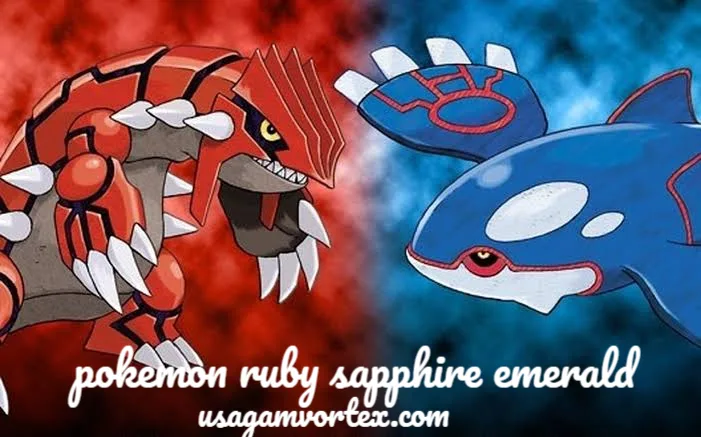
Pokemon Ruby, Pokemon Sapphire, and Pokemon Emerald remain some of the most recognizable classic Pokémon games. Released for the Game Boy Advance during Generation III, they introduced the Hoenn region, 135 new Pokémon, double battles, Abilities, Natures, Pokémon Contests, and a more strategically developed battle system. pokemon ruby sapphire emerald
Ruby and Sapphire debuted in Japan on November 21, 2002, followed by North America on March 19, 2003. Emerald arrived later, launching in Japan on September 16, 2004, and North America on May 1, 2005.pokemon ruby sapphire emerald
More than two decades later, the games are still important to the Pokémon franchise—not simply because of nostalgia, but because many mechanics and design ideas introduced in Gen 3 became foundations for later Pokémon games.
What Are Pokemon Ruby, Sapphire, and Emerald?
Ruby and Sapphire are the paired core Gen 3 adventures, while Emerald is an enhanced version that combines and expands elements from both games.
All three take place in the Hoenn region, a setting dominated by mountains, forests, islands, beaches, caves, and large stretches of ocean. The region introduced 135 new Pokémon, bringing the Generation III Pokédex to 386 Pokémon across the broader generation.
The basic Pokémon formula remains familiar:
- Choose a starter Pokémon.
- Explore towns, routes, caves, and waterways.
- Catch and train Pokémon.
- Challenge Gym Leaders.
- Earn eight Pokémon badges.
- Defeat the Elite Four and Champion.
- Complete as much of the Pokédex as possible.
- Battle and trade with other players.
What makes Gen 3 distinctive is how much more strategic the games became beneath that familiar structure.
Pokémon Ruby and Sapphire Gameplay
The Pokémon Ruby gameplay experience was a major technical step forward from the Game Boy Color era. The Game Boy Advance provided improved graphics, richer sound, larger environments, and more detailed Pokémon sprites.
The biggest gameplay additions included Double Battles, Abilities, Natures, Pokémon Contests, Berries, Poké Blocks, Secret Bases, and a more developed breeding and training system. The Pokémon Company specifically highlights Double Battles, Abilities, Natures, and Contests as major innovations introduced with Ruby and Sapphire.
Double Battles were especially influential. Instead of sending out one Pokémon at a time, Trainers could have two Pokémon fighting simultaneously. This opened the door to moves that could support allies, damage multiple opponents, or create combinations between Pokémon.
Hoenn Starters
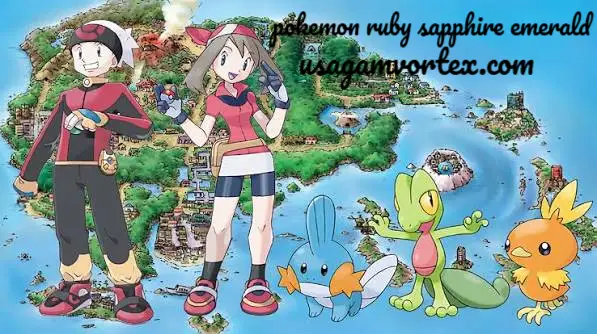
The three Hoenn Pokémon starters are:
| Starter | Type | General role |
|---|---|---|
| Treecko | Grass | Fast, offensive |
| Torchic | Fire | Strong offensive progression |
| Mudkip | Water | Excellent all-around option |
Mudkip became particularly popular because its final evolution, Swampert, gains the Water/Ground typing. Torchic eventually becomes Blaziken, while Treecko evolves into Sceptile.
Your starter choice has a noticeable effect on the early Pokémon Ruby and Pokémon Sapphire experience, but all three can form the foundation of a successful team.
Pokémon Ruby, Sapphire, and Emerald Story
Ruby and Sapphire center their conflict around the opposing philosophies of Team Magma and Team Aqua.
In Ruby, Team Magma is the primary villainous organization, while Sapphire emphasizes Team Aqua. Their objectives are deliberately opposed: Team Magma seeks to expand land, while Team Aqua wants to expand the oceans.
This conflict is tied directly to Hoenn’s legendary Pokémon:
- Groudon is associated with Ruby and Team Magma.
- Kyogre is associated with Sapphire and Team Aqua.
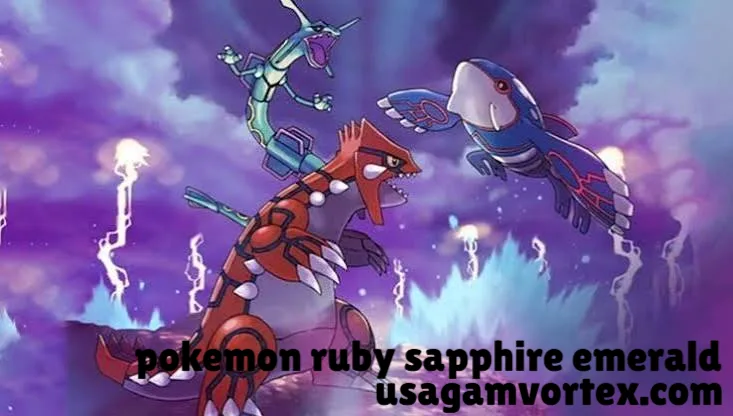
- Rayquaza becomes the central legendary figure in Emerald.
Emerald changes the narrative by bringing Team Magma and Team Aqua into the same larger conflict. Rayquaza plays a much more important role in restoring balance between Groudon and Kyogre. The official Pokémon site also highlights the legendary trio as one of the defining elements of the Hoenn setting.
This makes Emerald’s story more interconnected than the straightforward Ruby/Sapphire conflict.
What Makes Pokémon Emerald Different?
Pokémon Emerald is generally the most feature-rich version of the original Hoenn trilogy.
It is not simply Ruby or Sapphire with a different title screen. Game Freak altered the storyline, Gym Leader teams, Pokémon availability, locations, legendary encounters, and post-game content.
Some of Emerald’s most important additions include:
- A storyline involving both Team Magma and Team Aqua
- Rayquaza’s expanded role
- The Battle Frontier
- Updated Gym Leader teams
- Gym Leader rematches
- Battle Tents
- Animated Pokémon sprites
- Additional areas and encounters
- Revised legendary Pokémon encounters
- Additional post-game content
The Battle Frontier is arguably Emerald’s biggest gameplay advantage. Instead of Ruby and Sapphire’s Battle Tower, Emerald includes seven specialized battle facilities, each with its own rules and challenges.
For players who enjoy competitive-style Pokémon battling, the Battle Frontier gives Emerald considerably more longevity.
Pokémon Ruby/Sapphire/Emerald Battle System
Generation III established several mechanics that remain recognizable in modern Pokémon.
Abilities and Natures
Abilities give Pokémon passive effects that can influence battles, exploration, or team strategy. Natures add another layer to Pokémon stats by influencing their growth characteristics.
This means two Pokémon of the same species are not necessarily identical in battle.
Double Battles
Double Battles are one of Gen 3’s defining features. Positioning and move selection become much more important because every turn involves multiple Pokémon.
A move that looks mediocre in a one-on-one battle can become much more useful when paired with a Pokémon that benefits from it.
Important Gen 3 Battle Difference
One thing modern players should remember is that Gen 3 does not use the later physical/special split introduced in Generation IV.
In Gen 3, whether a move is physical or special is determined by its type rather than by the individual move. This can make some Pokémon and moves behave very differently compared with modern Pokémon games.
Pokémon, Pokédex, and Hoenn Exploration
Hoenn introduced many fan-favorite Pokémon, including:
- Mudkip
- Torchic
- Treecko
- Gardevoir
- Absol
- Mawile
- Sableye
- Milotic
- Metagross
- Salamence
- Rayquaza
- Kyogre
- Groudon
The official Pokédex still lists the core Hoenn sequence from #252 through #386, including Pokémon such as Milotic, Salamence, Metagross, Kyogre, Groudon, Rayquaza, Jirachi, and Deoxys.
The Hoenn map also places much greater emphasis on water than earlier regions. Surf is not merely an occasional traversal tool; large portions of the region are connected through oceans and waterways.
That gives the region a distinct identity, although some players find the extensive water routes slower than other Pokémon regions.
Ruby, Sapphire, and Emerald Version Exclusives
The original paired games use version-exclusive Pokémon to encourage trading.
Some notable Ruby/Sapphire differences include:
| Pokémon Ruby | Pokémon Sapphire |
|---|---|
| Seedot | Lotad |
| Nuzleaf | Lombre |
| Shiftry | Ludicolo |
| Mawile | Sableye |
| Zangoose | Seviper |
| Solrock | Lunatone |
| Groudon | Kyogre |
Mawile and Sableye are a classic example of complementary version exclusives: Mawile appears in Ruby while Sableye is exclusive to Sapphire in the original pair.
Emerald changes Pokémon availability and incorporates elements from both versions, although it should not simply be treated as having every Pokémon from Ruby and Sapphire.
Trading remains important if the goal is to complete the Pokédex.
Pokémon Ruby vs Sapphire vs Emerald: Which Should You Play?
For a first-time player, Emerald is usually the strongest overall choice because it combines the Hoenn adventure with substantial additional content.
Choose Ruby if:
- You prefer Groudon.
- You like Team Magma’s storyline.
- You want Ruby-exclusive Pokémon.
- You want the original version-specific experience.
Choose Sapphire if:
- Kyogre is your preferred legendary.
- You prefer Team Aqua.
- You want Sapphire-exclusive Pokémon.
- You enjoy the ocean-focused side of Hoenn.
Choose Emerald if:
- You want the most complete original Hoenn experience.
- You want Rayquaza to play a larger role.
- You want the Battle Frontier.
- You want a revised storyline.
- You plan to spend significant time in the post-game.
For a pure single-player playthrough, Emerald is the easiest recommendation.
Pokémon Ruby Sapphire Emerald on Switch: Can You Play Them?
No. As of October 2026, the original Pokémon Ruby, Sapphire, and Emerald games are not officially available on Nintendo Switch or Switch 2.
Nintendo’s current Game Boy Advance – Nintendo Classics library contains selected GBA titles rather than the entire GBA catalog. Its listed Pokémon release is Pokémon Mystery Dungeon: Red Rescue Team, not the original Hoenn games.
Nintendo did release Pokémon FireRed and Pokémon LeafGreen as standalone digital games for Switch on February 27, 2026, but that release does not include Ruby, Sapphire, or Emerald. Nintendo also states that FireRed and LeafGreen are separate software releases rather than additions to the GBA Nintendo Classics collection.
Therefore, someone searching for Pokemon ruby sapphire emerald switch should not confuse the availability of FireRed and LeafGreen with an official Switch release of the Hoenn trilogy.
Pokémon Ruby/Sapphire/Emerald: Graphics, Sound, and Performance
For Game Boy Advance hardware, these games were technically impressive.
The colorful environments, improved Pokémon sprites, weather effects, water routes, battle animations, and richer soundtrack gave Hoenn a substantial visual identity.
Emerald went further by bringing animated Pokémon entrances back to the series and adding animated back sprites.
Today, the graphics obviously look dated beside modern Pokémon games. However, the pixel-art presentation has aged well because the games use strong environmental colors and clear sprite designs rather than trying to imitate modern 3D visuals.
Performance is generally smooth on original hardware, with the main limitations coming from the Game Boy Advance’s technical constraints rather than poor optimization.
Pokémon Ruby, Sapphire, and Emerald Game Mechanics
The Gen 3 experience revolves around a surprisingly deep collection of systems:
- Pokémon catching and evolution
- Abilities and Natures
- Held items
- Breeding
- EV and IV-based stat development
- Double Battles
- Pokémon Contests
- Berries and Poké Blocks
- Secret Bases
- PokéNav
- Trading
- Trainer rematches
- Gym battles
- Elite Four progression
- Post-game battle facilities
The games also retain the familiar Pokémon Center healing system and Poké Ball-based catching mechanics, making them approachable even for newcomers.
At the same time, players interested in optimizing Pokémon teams can spend considerably more time exploring the underlying mechanics.
Pokémon Ruby Sapphire Emerald Pros and Cons
Pros
- Excellent Hoenn region design
- Strong collection of new Pokémon
- Memorable legendary trio
- Double Battles and Abilities add strategic depth
- Pokémon Contests provide an alternative activity
- Emerald offers a substantial Battle Frontier
- Excellent retro presentation
- Strong replay value
- Trading gives the games a genuine two-player dimension
Cons
- Original hardware and connectivity can be inconvenient today
- Extensive water routes are not everyone’s favorite
- Gen 3 lacks the modern physical/special move split
- Completing the Pokédex requires multiple games and trading
- Some Pokémon have awkward move pools or evolution requirements
- The original versions are not currently available on Switch
Is Pokémon Ruby, Sapphire, or Emerald Worth Playing?
Yes—especially Emerald.
The strongest reason to play these games today is not simply nostalgia. Gen 3 represents an important transition point for the Pokémon franchise. Ruby and Sapphire introduced systems that would influence Pokémon battling and Pokémon training for years, while Emerald demonstrated how an enhanced version could significantly expand an existing adventure.
If you have never played a Gen 3 Pokémon game, Emerald is the best starting point. If you’re interested in experiencing the original version-exclusive structure, Ruby and Sapphire are still worthwhile.
For modern Switch owners, however, there is currently no official way to simply download the original Hoenn trilogy from Nintendo’s Switch catalog.
source: pokemondb.net
Final Verdict
Pokémon Ruby, Sapphire, and Emerald remain excellent classic Pokémon games, with Emerald standing as the strongest all-around version.
Ruby and Sapphire established Hoenn, introduced 135 new Pokémon, and expanded the battle system with Abilities, Natures, Double Battles, and Contests. Emerald refined that foundation with a stronger story, additional encounters, revised Gym battles, and the exceptional Battle Frontier.
For collectors and retro players, the original cartridges remain historically significant Game Boy Advance Pokémon releases. For someone choosing one game to experience the Hoenn adventure today, Emerald is the most complete choice.
Custom FAQ
Pokemon ruby sapphire emerald switch
Can you play Pokémon Ruby, Sapphire, and Emerald on Nintendo Switch?
No. As of October 2026, the original Pokémon Ruby, Pokémon Sapphire, and Pokémon Emerald are not officially available on Nintendo Switch or Switch 2. Nintendo’s GBA Nintendo Classics library includes selected games, but the original Hoenn trilogy is not currently listed. FireRed and LeafGreen were released separately for Switch in February 2026.
Pokemon ruby and sapphire
What is the difference between Pokémon Ruby and Sapphire?
The two games share the same basic Hoenn adventure but have different version-exclusive Pokémon, legendary mascots, and villainous Team emphasis. Ruby features Groudon and Team Magma, while Sapphire features Kyogre and Team Aqua.
Pokemon ruby and sapphire switch
Are Pokémon Ruby and Sapphire available on Switch?
No. Neither original Game Boy Advance game is currently listed in Nintendo’s Switch or Game Boy Advance Nintendo Classics catalog as of October 2026.
Pokémon Ruby/Sapphire/Emerald exclusives
What are the Pokémon Ruby, Sapphire, and Emerald exclusives?
Ruby and Sapphire have several opposing version-exclusive Pokémon, including Seedot in Ruby versus Lotad in Sapphire, Mawile versus Sableye, Zangoose versus Seviper, and Solrock versus Lunatone. Emerald changes the available Pokémon and incorporates elements from both original versions.
Pokemon ruby sapphire emerald starters
What are the Pokémon Ruby, Sapphire, and Emerald starters?
All three games offer the same three Hoenn starters: Treecko, the Grass type; Torchic, the Fire type; and Mudkip, the Water type.
Also Read