Introduction
If you have spent any time on Netflix lately, chances are you have already fallen head-over-heels for KPop Demon Hunters. And at the center of it all stands Rumi — the half-demon, half-human idol who became an instant animated icon in 2025. Fans across the world are obsessed with her look. Her rumi kpop demon hunters full body design is one of the most detailed, symbolically loaded character visuals in recent animation history.
So what exactly makes Rumi’s full body design so striking? From her signature purple dragon braid to the glowing demon markings that creep across her skin, every element of her appearance tells a story. Whether you are a fan searching for reference art, a cosplayer planning your next costume, or just someone who wants to understand this character on a deeper level — this article breaks down everything.
We will walk through her physical appearance, her multiple outfits, what her demon markings actually mean, and how her look changes as the story unfolds.
Who Is Rumi from KPop Demon Hunters?
Before we get into the visual details, it helps to understand who Rumi actually is.
Rumi Kang (강루미) is the main protagonist of KPop Demon Hunters, Sony Pictures Animation’s 29th feature film, released on Netflix on June 20, 2025. She is the leader and main vocalist of HUNTR/X (pronounced “Huntrix”), a three-member K-pop girl group that secretly doubles as a demon-hunting squad.
The film became Netflix’s most-watched animated feature ever, pulling in over 236 million views worldwide. Arden Cho provides Rumi’s speaking voice, while EJAE handles her singing vocals — a combination that gives Rumi an authenticity that resonates deeply with fans of Korean pop culture.
What makes Rumi so compelling is her internal conflict. She is half-demon, a secret she hides from the world. She covers her demon markings, suppresses her powers, and channels all of that tension into her performances on stage.
Her full body design carries that entire emotional arc visually.
Rumi KPop Demon Hunters Full Body: Physical Appearance Breakdown
When you look at the rumi kpop demon hunters full body design, you notice it is layered with detail. Nothing about her look is accidental.
Face and Skin
Rumi has a classic Korean beauty aesthetic built into her design. She has:
- A fair complexion with a warm sand-yellow undertone
- An oval-shaped face with soft, balanced features
- A small, rounded bulb nose and full lips
- Monolid coffee-brown eyes that read as warm but intense
- Dark, long lashes that frame her gaze
Her overall face is described in the source material as a “Korean classic beauty” — a deliberate design choice that grounds her in a real cultural identity rather than a generic animated aesthetic.
Hair
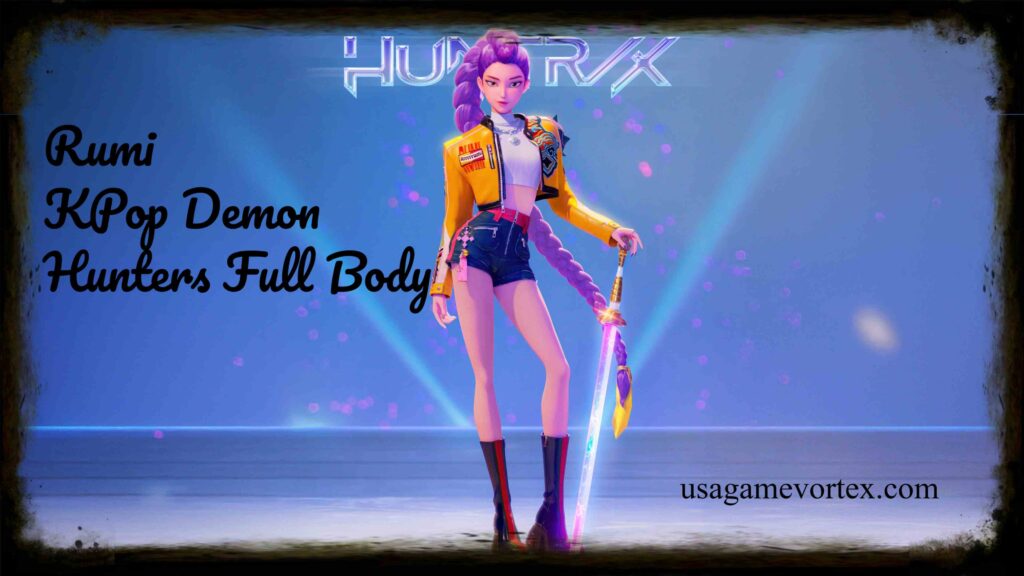
This is Rumi’s most immediately recognizable feature. Her hair is a vivid, brilliant purple — a shade so saturated it practically glows off the screen. It is styled into a thick dragon braid that begins right at her hairline and flows all the way down to her calves.
The braid is tied back with a golden silk daenggi, a traditional Korean hair ribbon. This is a quiet but meaningful detail. The animators fused K-pop idol energy with traditional Korean culture in a single hair accessory.
Here is something fans often debate: is the purple hair dye, or is it naturally her demon heritage? Because she had purple hair even as a child, many fans believe it is a biological feature of her half-demon nature — though the film never confirms this directly.
Body and Build
Rumi has a slim, athletic build described as having a flared rib cage. She has average height for a young Korean woman in her early-to-mid twenties (around 23–24 years old).
Her build reflects both sides of her identity. She is lithe enough to move across a stage with K-pop precision. She is also muscular and capable enough to fight demons with real physical power.
The Demon Markings: The Most Powerful Part of Her Full Body Design
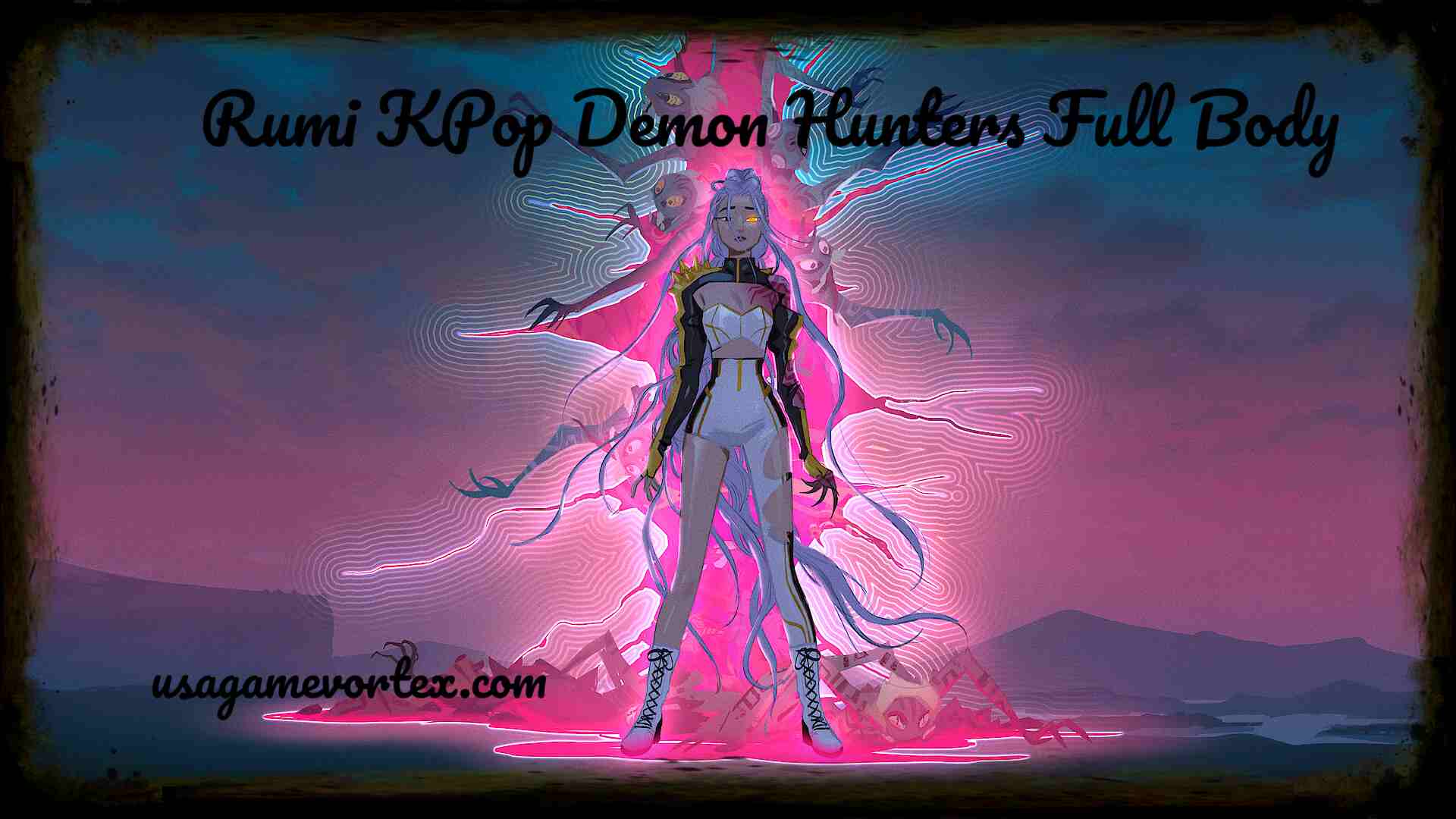
The demon markings are what truly define Rumi’s full body visual identity. They are not just decoration — they are the physical manifestation of her inner conflict.
What Do the Markings Look Like?
The markings appear as purple patterns across her skin that resemble eldritch symbols. They run primarily along her arms but spread across her body as the story escalates. Think loose, organic stripes that look like they were drawn in a language older than humanity.
They behave dynamically depending on her emotional state:
- Under stress — the markings glow pink
- When angered or frightened — they become more visible and spread
- When confronting Celine — her left eye shifts from brown to gold with a slitted pupil, and her hands become clawed
- At the film’s end — after Rumi fully accepts her heritage, the markings appear more openly on her skin and display an iridescent sheen
That final transformation is one of the most visually beautiful moments in the film. The markings stop being something shameful and become something radiant.
Why Does She Hide Them?
Rumi was raised by Celine, a demon hunter who told her to keep the markings hidden at all costs. Celine believed that if Rumi fulfilled her destiny and summoned the Golden Honmoon — a mystical barrier — the markings might disappear entirely, making Rumi “fully human.”
So Rumi grew up treating her own body as a problem to be fixed. Her white mockneck crop top is not just a fashion choice. It is literally armor against her own identity.
That is what makes her full body design so emotionally resonant. You are not just looking at a cool character design. You are looking at a young woman who has been taught to hide herself.
Rumi’s Outfits: From the Stage to the Streets
One of the best things about the rumi kpop demon hunters full body character design is how her wardrobe shifts across different contexts.
Stage Outfit (Performance Look)
Rumi’s primary performance look is her most iconic. It combines K-pop idol glamour with subtle demon hunter functionality:
- A white mockneck crop top that hides her demon markings on her upper body
- High-waisted dark indigo denim shorts
- A hot pink belt with a light purple norigae tassel (another traditional Korean accessory)
- Two chunky silver chain necklaces
- Black platform combat boots with red stripes
This outfit balances three identities at once. She is a pop star. She is a fighter. And she is someone hiding who she really is. The norigae tassel is especially clever — it ties her to Korean heritage while sitting right at the intersection of tradition and modernity.
Casual and Off-Stage Looks
Throughout the film, Rumi cycles through different outfit variations that fit the tone of each scene. Vibrant stage looks give way to more grounded, street-level fits during quieter, emotional moments. Each transition reflects where she is emotionally in the story.
Her wardrobe acts as a visual diary of her character arc.
End-of-Film Look
By the film’s conclusion, after she accepts her demon heritage, her look opens up. The demon markings are no longer hidden. They appear subtly but proudly across her skin, now with that iridescent quality that feels almost magical rather than monstrous.
This is the most fully realized version of her full body design — the look the entire film was building toward.
How the Character Design Was Created
The story of how Rumi came to exist is genuinely charming.
Rumi was originally created in 2016 for a completely different project — a concept called “Plastic Walrus” by artist Redford Sechrist. Director Maggie Kang fell in love with the design and pulled Rumi out to become the main character of KPop Demon Hunters. She loved the name so much she even named her own daughter Rumi — who then voices young Rumi in the film.
That kind of personal investment shows in every frame. This is not a character designed by committee. She was born from genuine creative love.
Maggie Kang’s goal from the very start was to see Korean people represented authentically in animation. Rumi’s design reflects that — from her Korean facial features to her traditional accessories to her cultural context.
Why Fans Are So Obsessed with Rumi’s Full Body Design
There are a few specific reasons Rumi has become such a beloved character visually.
She looks real. Her features are not exaggerated or flattened into a generic “anime girl” template. She looks like a Korean woman. That representation matters enormously to a fanbase that rarely sees itself on screen.
Her design tells her story. You can read her entire emotional arc just by looking at her body at different points in the film. The markings tell you everything.
She is a cosplay dream. She became the number one trending Halloween costume in 2025, according to Google’s Frightgeist. The iconic purple braid, the crop top, the combat boots — it is accessible and instantly recognizable.
She ages into herself. Her design does not stay static. It evolves with her emotional journey, which is rare and impressive in feature animation.
Rumi vs. the Rest of HUNTR/X: How Her Design Stands Apart
Within the trio, each character has a visually distinct identity.
Mira has pink hair and a more aggressive, sarcastic energy that comes through in her sharper design choices. Zoey leans into a softer, more bubbly aesthetic with space buns and warmer tones.
Rumi occupies the middle ground in terms of vibe but dominates in terms of visual complexity. Her design carries the most narrative weight because she is the main character carrying the central conflict.
If Zoey’s look says “fun and free,” and Mira’s says “fierce and guarded,” Rumi’s says “powerful and hiding it.”
What the Rumi Design Means for Animated Representation
This is worth pausing on. The rumi kpop demon hunters full body design is not just cool art. It is part of a larger cultural shift.
For years, animated films gave Asian characters either supporting roles or heavily stylized designs that erased their cultural specificity. Rumi is different. She is the lead. Her Koreanness is not incidental — it is the point.
The traditional Korean accessories, the culturally grounded facial features, the integration of Korean mythology and demonology into her very body — it all works together to say: this character comes from somewhere specific and she is proud of it.
That message lands even harder because the entire film is about accepting your full identity, demon markings and all.
Conclusion
Rumi Kang’s full body design from KPop Demon Hunters is one of the most intentional and emotionally loaded character visuals in recent animated film. From her purple dragon braid and golden daenggi ribbon to her glowing eldritch demon markings and stage-ready combat boots, every detail is doing narrative work.
She is a character whose outside tells you exactly what is happening inside. And that, more than anything, is what makes great character design.
If you have not seen the film yet, the visual journey alone is worth it. And if you have already watched it, go back and pay attention to how her markings evolve across each scene. You will notice things you missed the first time.
What is your favorite detail from Rumi’s design — the dragon braid, the demon markings, or something else entirely? Drop your thoughts and share this with a fellow fan who needs to see it.
Frequently Asked Questions
1. What does Rumi’s full body look like in KPop Demon Hunters? Rumi has a slim, athletic build with fair skin, a warm sand-yellow undertone, and monolid brown eyes. Her most striking feature is her vivid purple dragon braid that reaches her calves. Her arms and body are covered in purple eldritch demon markings that glow pink under stress.
2. Are Rumi’s demon markings always visible? No. For most of the film, Rumi actively hides her markings by wearing a white mockneck crop top. The markings become more visible when she is emotional, and by the film’s end she stops hiding them entirely.
3. Why does Rumi have purple hair? The film never explicitly confirms why. Since she had purple hair as a child before any dye could be involved, many fans believe it is a biological result of her half-demon heritage rather than a style choice.
4. Who designed Rumi’s character? Rumi was originally designed by artist Redford Sechrist for a project called “Plastic Walrus” in 2016. Director Maggie Kang loved the design so much she made Rumi the lead character of KPop Demon Hunters.
5. What does Rumi wear in the film? Her signature stage outfit includes a white mockneck crop top, high-waisted dark indigo denim shorts, a hot pink belt with a purple norigae tassel, chunky silver chain necklaces, and black platform combat boots with red stripes.
6. How does Rumi’s look change throughout the film? Her most dramatic transformation comes at the film’s end. Once she accepts her half-demon identity, her markings are no longer hidden — they appear openly on her skin with an iridescent sheen.
7. What does Rumi’s demon form look like? In moments of extreme power or emotion, Rumi’s left eye shifts from brown to gold with a slitted pupil. Her hands become clawed. Her demon markings spread further and glow more intensely.
8. Who voices Rumi in KPop Demon Hunters? Arden Cho provides Rumi’s speaking voice. EJAE provides her singing voice. Rumi Oak (the director’s daughter) voices young Rumi in flashback scenes.
9. Why did Rumi become a top Halloween costume in 2025? Her design is iconic and very achievable. The core costume elements — purple braid, crop top, combat boots — are instantly recognizable and relatively easy to replicate. Google Frightgeist listed her as the number one trending Halloween costume of 2025.
10. Is Rumi’s design based on real K-pop idols? Not directly, though her aesthetic draws heavily from real K-pop visual culture. Director Maggie Kang described the film as having a “BLACKPINK-esque” energy, and the design team worked to blend authentic Korean cultural elements with contemporary K-pop idol aesthetics.
visit: usagamevortex.com
email: johanharwen@314gmail.com
Author Name: Jordan Reyes
Author Bio: Jordan Reyes is a pop culture writer and animation enthusiast with five years of experience covering animated films, character design, and the intersection of music and visual storytelling. Jordan has written for multiple entertainment platforms and holds a particular passion for how representation in animation shapes culture. When not writing, Jordan is probably rewatching a favorite animated feature and taking notes on the art direction.