
Introduction
Have you ever wondered what enzyme breaks down starch in the food you eat? The answer is amylase, a digestive enzyme that helps break complex starch molecules into smaller carbohydrates that the body can process and eventually use for energy. Starch is found in common foods such as rice, potatoes, bread, pasta, and cereals, making its digestion an important part of everyday nutrition.
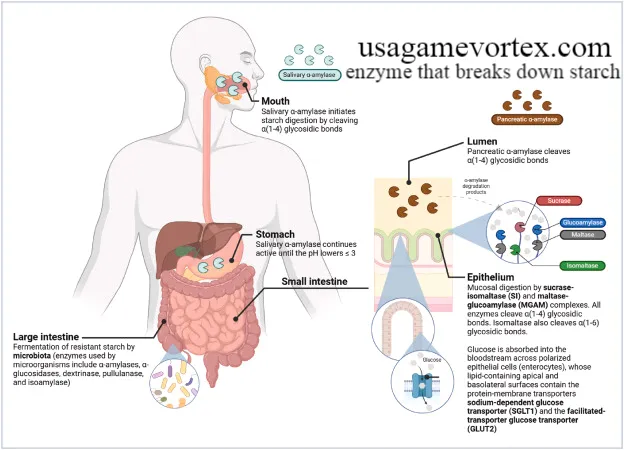
Amylase begins working in the mouth, where salivary amylase starts breaking down starch during chewing. The process continues in the small intestine, where pancreatic amylase helps digest the remaining starch. Although amylase is essential for normal carbohydrate digestion, enzyme activity can be affected by factors such as pH, temperature, and digestive health. In this guide, you’ll learn how the enzyme that breaks down starch works, where it is produced, why it matters, and the important facts and potential risks associated with abnormal amylase levels.
What Is the Enzyme That Breaks Down Starch?
The main enzyme that breaks down starch is amylase. Your body produces amylase mainly in the salivary glands and pancreas. This digestive enzyme changes large starch molecules into smaller carbohydrates that your body can process and eventually use for energy.
Starch appears in everyday foods such as bread, rice, potatoes, pasta, cereals, corn, and many other plant foods. Your digestive system cannot absorb starch in its original large form. Instead, enzymes break it into smaller sugars.
The enzyme that breaks down starch starts working in your mouth when you chew food. Digestion continues in the small intestine, where pancreatic amylase performs much of the work.
Understanding this process helps you see why chewing, digestion, blood glucose, and carbohydrate metabolism are closely connected. It also explains why amylase plays such an important role in human nutrition.
What Enzyme Breaks Down Starch?
Amylase is the primary enzyme that breaks down starch in the human digestive system.
There are two major forms involved in human digestion:
- Salivary amylase, produced by the salivary glands
- Pancreatic amylase, produced by the pancreas
Both enzymes act on starch, but they work in different parts of your digestive system.
Amylase breaks the chemical bonds within starch and produces smaller carbohydrates. These products include maltose and shorter carbohydrate chains called dextrins.
Other enzymes then continue the digestive process until carbohydrates become simple sugars that your small intestine can absorb.
Does Amylase Break Down Starch?
Yes. Amylase directly breaks down starch.
Starch consists mainly of two types of glucose based molecules called amylose and amylopectin. Amylase attacks specific bonds within these molecules.
The process does not immediately turn all starch into glucose. Instead, amylase first produces smaller carbohydrate molecules. Other digestive enzymes finish the process later.
This step by step process allows your body to extract energy from carbohydrate rich foods efficiently.
Where Does Starch Digestion Begin?
Starch digestion begins in your mouth.
When you chew food, your salivary glands release saliva containing salivary amylase. The enzyme begins breaking down starch while the food is still in your mouth.
This is one reason chewing matters. Your teeth physically break food into smaller pieces, while saliva begins the chemical digestion of starch.
Once you swallow, the food travels through your esophagus into your stomach.
Interestingly, stomach acid reduces the activity of salivary amylase. As a result, starch digestion slows significantly in the stomach.
The process becomes active again when partially digested food reaches the small intestine.
How Does the Enzyme That Breaks Down Starch Work?
The enzyme that breaks down starch works through a process called enzymatic hydrolysis.
Here is the basic process:
- You eat a starch containing food.
- Your teeth break the food into smaller pieces.
- Salivary amylase begins starch digestion.
- The stomach temporarily reduces amylase activity.
- The pancreas releases pancreatic amylase into the small intestine.
- Amylase produces smaller carbohydrate molecules.
- Other enzymes convert these molecules into simple sugars.
- Your small intestine absorbs the resulting sugars.
This process shows that carbohydrate digestion depends on several enzymes working together.
Amylase performs an important early step, but it does not complete carbohydrate digestion by itself.
What Happens to Starch After Amylase Breaks It Down?
Amylase produces smaller carbohydrates rather than completing the entire digestive process.
For example, starch can become maltose and other shorter carbohydrate chains. An enzyme called maltase can then break maltose into glucose.
Glucose can enter the bloodstream through the small intestine. Your cells can use glucose as an energy source.
Your pancreas also produces insulin in response to rising blood glucose. Insulin helps many cells take glucose from the blood.
This explains why starch digestion connects directly with energy metabolism and blood glucose regulation. source: PubMed Central (PMC) (.gov)
Which Foods Contain Starch?
Starch is common in many plant based foods. Some foods contain considerably more starch than others.
| Food | Main Starch Source | Common Role |
|---|---|---|
| Rice | Rice grains | Main carbohydrate |
| Potatoes | Potato tubers | Main carbohydrate |
| Bread | Wheat flour | Bakery staple |
| Pasta | Wheat flour | Main carbohydrate |
| Corn | Corn kernels | Grain and vegetable |
| Oats | Oat grains | Breakfast food |
| Beans | Legumes | Carbohydrate and protein |
| Cereals | Various grains | Breakfast food |
The amount and structure of starch can vary depending on the food and how you prepare it.
Cooking can change starch structure and make some starch easier for digestive enzymes to access. Cooling certain cooked foods can also increase resistant starch.

What Is Resistant Starch?
Resistant starch is a type of starch that resists digestion in the small intestine.
Instead of being completely broken down by the usual digestive enzymes, some resistant starch reaches the large intestine.
There, gut microorganisms can ferment it and produce short chain fatty acids.
Common sources include:
- Cooked and cooled potatoes
- Cooked and cooled rice
- Certain whole grains
- Legumes
- Green bananas
The amount of resistant starch depends on the food, cooking method, storage conditions, and processing.
This is an important area of nutrition research because resistant starch behaves differently from rapidly digestible starch.
Salivary Amylase vs Pancreatic Amylase
Both enzymes belong to the amylase family, but their locations differ.
| Feature | Salivary Amylase | Pancreatic Amylase |
|---|---|---|
| Produced by | Salivary glands | Pancreas |
| Main location | Mouth | Small intestine |
| Main role | Starts starch digestion | Continues major starch digestion |
| Works on starch | Yes | Yes |
| Importance | Early digestion | Major intestinal digestion |
Together, these enzymes make starch digestion efficient.
The digestive system does not depend on one enzyme alone. It uses several enzymes in sequence.
Why Is Amylase Important for Your Body?
The enzyme that breaks down starch helps your body access energy stored in carbohydrate rich foods.
Carbohydrates provide about 4 calories per gram when metabolized. Starch therefore represents an important source of dietary energy.
Your body ultimately converts digestible starch into glucose and other simple sugars. Cells can then use these molecules to produce energy.
Amylase also demonstrates an important principle of digestion. Your body uses specialized enzymes to transform large food molecules into smaller molecules that can cross the intestinal wall.
What Happens If Amylase Does Not Work Properly?
Your digestive system normally produces enough amylase to digest typical amounts of starch.
However, problems affecting the pancreas can sometimes reduce digestive enzyme production. Certain pancreatic conditions can therefore interfere with normal digestion.
Low digestive enzyme activity may contribute to symptoms such as:
- Bloating
- Abdominal discomfort
- Changes in bowel movements
- Poor digestion of certain foods
- Nutrient absorption problems in some conditions
These symptoms can have many different causes. You should not assume that low amylase is responsible without appropriate medical evaluation.
Blood amylase testing can also be used in specific medical situations, particularly when healthcare professionals evaluate pancreatic problems.
How Is Amylase Used Outside the Human Body?
Amylase has important uses beyond human digestion.
Food manufacturers use enzymes to improve various production processes. Amylases can help convert starch into smaller carbohydrates during baking, brewing, and carbohydrate processing.
Major enzyme companies such as Novonesis and DSM Firmenich have developed enzyme technologies for food and industrial applications.
Amylase can also play a role in producing sweeteners from starch. Industrial enzyme systems allow manufacturers to control carbohydrate conversion efficiently.
This shows that the enzyme that breaks down starch is important not only inside your digestive system but also across the food industry.
What Does Current Research Tell Us About Starch Digestion?
Modern nutrition research increasingly focuses on the difference between rapidly digestible starch, slowly digestible starch, and resistant starch.
The speed of starch digestion can affect how quickly glucose enters the bloodstream. Food structure, processing, cooking, fiber content, and starch type can all influence this response.
A practical research based insight is simple: the same amount of carbohydrate does not always behave identically in the body.
For example, whole foods may have a different digestive response than highly processed foods. Cooking and cooling can also change the structure of some starches.
Experts in digestive physiology generally emphasize that carbohydrate digestion is a coordinated process rather than the action of a single enzyme.
Frequently Asked Questions
What is the main enzyme that breaks down starch?
Amylase is the main enzyme that breaks down starch during human digestion. Salivary amylase starts the process, while pancreatic amylase continues it in the small intestine.
Does amylase turn starch directly into glucose?
No. Amylase first breaks starch into smaller carbohydrates. Other enzymes then convert those carbohydrates into simple sugars such as glucose.
Where does starch digestion begin?
Starch digestion begins in the mouth. Salivary amylase starts breaking down starch as you chew food.
What enzyme breaks down starch in the small intestine?
Pancreatic amylase breaks down starch in the small intestine. Additional enzymes complete carbohydrate digestion afterward.
Does cooking affect starch digestion?
Yes. Cooking changes the physical structure of starch and can make it easier to digest. Cooling some cooked foods can increase resistant starch.
Is starch the same as sugar?
No. Starch is a complex carbohydrate made from many glucose units. Simple sugars contain much smaller carbohydrate molecules.
What foods contain a lot of starch?
Rice, potatoes, bread, pasta, corn, oats, cereals, and many legumes contain significant amounts of starch.
Can your body digest all starch?
No. Some starch becomes resistant starch and passes into the large intestine instead of being fully digested in the small intestine.
Final Takeaway
The enzyme that breaks down starch is mainly amylase. Salivary amylase begins the process in your mouth, while pancreatic amylase continues it in your small intestine.
Amylase does not complete carbohydrate digestion alone. It creates smaller carbohydrates that other enzymes process into absorbable sugars.
Once you understand this pathway, starch digestion becomes much easier to understand. From rice and potatoes to bread and oats, the same basic biological system helps your body turn starch into usable energy.
If you are interested in nutrition, digestion, or blood glucose, learning how amylase works gives you a useful foundation. The next time you eat a starchy meal, you can remember that digestion starts long before the food reaches your stomach.
Author Bio: Awais khan The author writes clear, research informed health and nutrition content designed to make complex biological topics easy to understand. The focus is on practical explanations, accurate terminology, and reader friendly educational information.
email: johanharwen@314gmail.com
Author Name: Awais khan